Kalshi traders holding Michigan got to find out. The exchange prematurely settled its Western Michigan vs. Michigan football market as a Western Michigan win. It then reversed the incorrect payouts and paid Michigan holders, according to reporting citing confirmation obtained by CNN’s Marshall Cohen.
The game had looked finished. On September 5, Western Michigan led 12–7 when Michigan’s apparent final Hail Mary fell incomplete. The clock showed zero, and Western Michigan players began celebrating. Officials reviewed the play, ruled that a defender had touched the ball while out of bounds with time remaining, and restored one second.
Bryce Underwood used it to throw a 47-yard touchdown to JJ Buchanan. Michigan won 13–12.
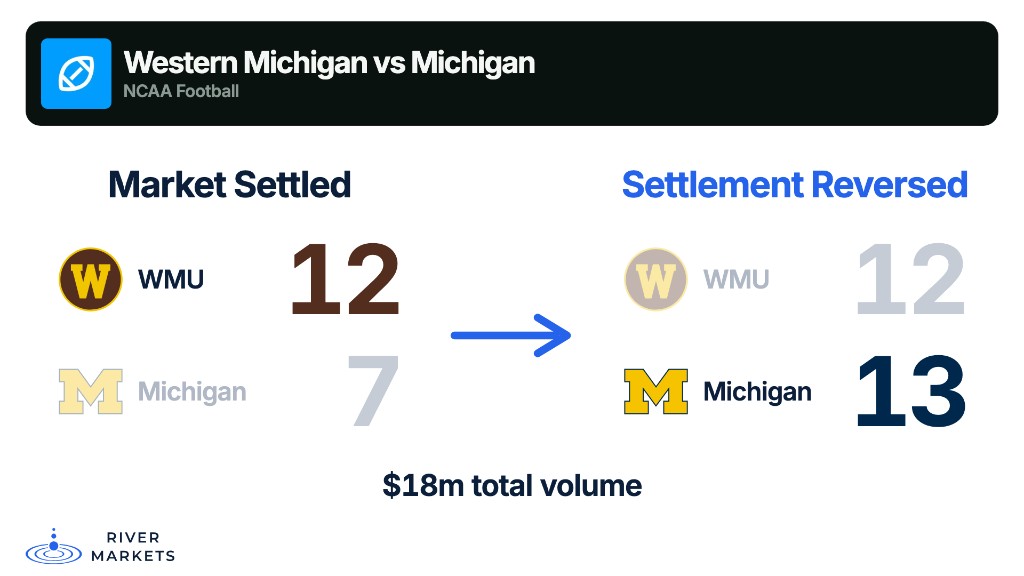
Kalshi had already paid the Western Michigan side. What looked like a completed trade now required a reversal. The market reportedly saw $18.6 million in trading volume, although the amount incorrectly distributed has not been established by the reporting cited here.
On Polymarket’s international platform, the market correctly finished in Michigan’s favor. Its rules tied resolution to the completed game, including overtime if needed, and explicitly kept the market open through postponements. That brings the question into focus: how does a venue confirm that play is actually over before releasing payouts?
Why settle a game whose final play could still be reviewed?
Kalshi’s published process says settlement follows confirmation of the official outcome and finalization by its markets team. Winning contracts then pay into the trader’s cash balance. Its documentation also distinguishes trading close time from outcome determination: an event appearing to have ended does not necessarily mean the exchange has the official result required to settle it.
A clock showing zero is convincing enough to celebrate. Paying out a contract requires checking whether the result can still change under the game’s review process. That is a foreseeable part of settling a football market, even when the ending itself is unusual.
The reporting establishes that Kalshi settled early and corrected the payouts. It does not provide a detailed technical explanation of what triggered the settlement or why the checks failed. Without that account, attributing the incident to a particular data feed, automation or human decision would be guessing.
What happens between the payout and its reversal
For traders, the next question is what happens between the payout and its reversal.
Suppose a strategy uses a newly credited payout to size another order. If the first settlement is reversed after the second order fills, the trader has already acted on a balance that was wrong. Restoring the original account balance would not undo that subsequent trade.
Or consider a desk holding a position alongside a hedge elsewhere. If it closes the hedge because the first position appears settled, a reversal could leave it exposed again.
These are hypothetical consequences; the reporting cited here does not establish that either occurred. They are reasons to ask how an exchange communicates corrections and how trading systems handle them. A settlement update can affect available capital, position records and the decision to keep or remove a hedge.
Which result counts
The game also produced a separate dispute over which result should count. On September 8, the Mid-American Conference challenged the replay procedure and asked the NCAA and College Football Playoff to recognize Western Michigan as the winner for rankings, evaluations and selection deliberations. The appeal itself did not establish a changed official result.
That leaves an exchange needing explicit rules for both the authoritative result and the point at which it will act on it. Kalshi says each contract’s terms specify the rules, information and source used to determine the outcome. Traders need to understand those terms before assuming that the end of the broadcast, an official result and a settled position are interchangeable.
Kalshi corrected the mistake. The unanswered question is what would prevent the same premature settlement next time: which confirmation was missing, and what now requires the exchange to wait for it?