A macro portfolio usually expresses a view on an economic release indirectly.
A trader who expects a soft CPI print might buy duration, receive rates, or trade an inflation option. Each instrument carries exposure to more than the release itself. Rates can move for reasons unrelated to CPI. Options bring volatility, convexity, and expiry effects into the trade. The position may be directionally right on the data and still lose money.
Economics-linked prediction markets offer a narrower instrument. A contract can settle directly on the next Fed decision, monthly CPI, nonfarm payrolls, unemployment, GDP, PCE inflation, or initial jobless claims. The question is defined in advance, the maximum payout is fixed, and settlement follows the official release.
That precision is useful. It does not make the trade easy.
Professional use requires more than choosing YES or NO. A desk has to compare contract definitions, understand how the event is bucketed, manage the roll from one release to the next, and execute across fragmented order books. At meaningful size, the execution problem can matter as much as the forecast.
The economic calendar is becoming a contract universe
The market now covers much of the recurring U.S. macro calendar:
| Contract family | Reference event | Common structure | Typical cycle |
|---|---|---|---|
| Fed rate decision | FOMC target-rate decision | Binary or outcome bucket | Per meeting |
| Fed cut or hike count | Cumulative policy moves by a date | Binary or bracket | Quarterly or annual |
| CPI and core CPI | Official inflation release | Range bracket or threshold | Monthly |
| Nonfarm payrolls | Headline payroll number | Range bracket | Monthly |
| Unemployment | U-3 unemployment rate | Threshold or bracket | Monthly |
| GDP growth | Advance GDP estimate | Range bracket | Quarterly |
| PCE inflation | PCE price index | Threshold or bracket | Monthly |
| Initial claims | Weekly jobless claims | Range bracket | Weekly |
These contracts turn a forecast into a defined payoff. If the question is whether CPI will print between 0.3% and 0.4% month over month, the position settles on that bracket. If the question is whether the Fed will leave rates unchanged, the contract settles on the announced decision.
The result is a cleaner connection between the research view and the payout. It also makes assumptions easier to audit. The desk can state the event, probability, entry price, maximum loss, and settlement source before entering the trade.
Prices form a distribution around the consensus
Bracket markets are especially useful because the full set of prices describes a market-implied distribution.
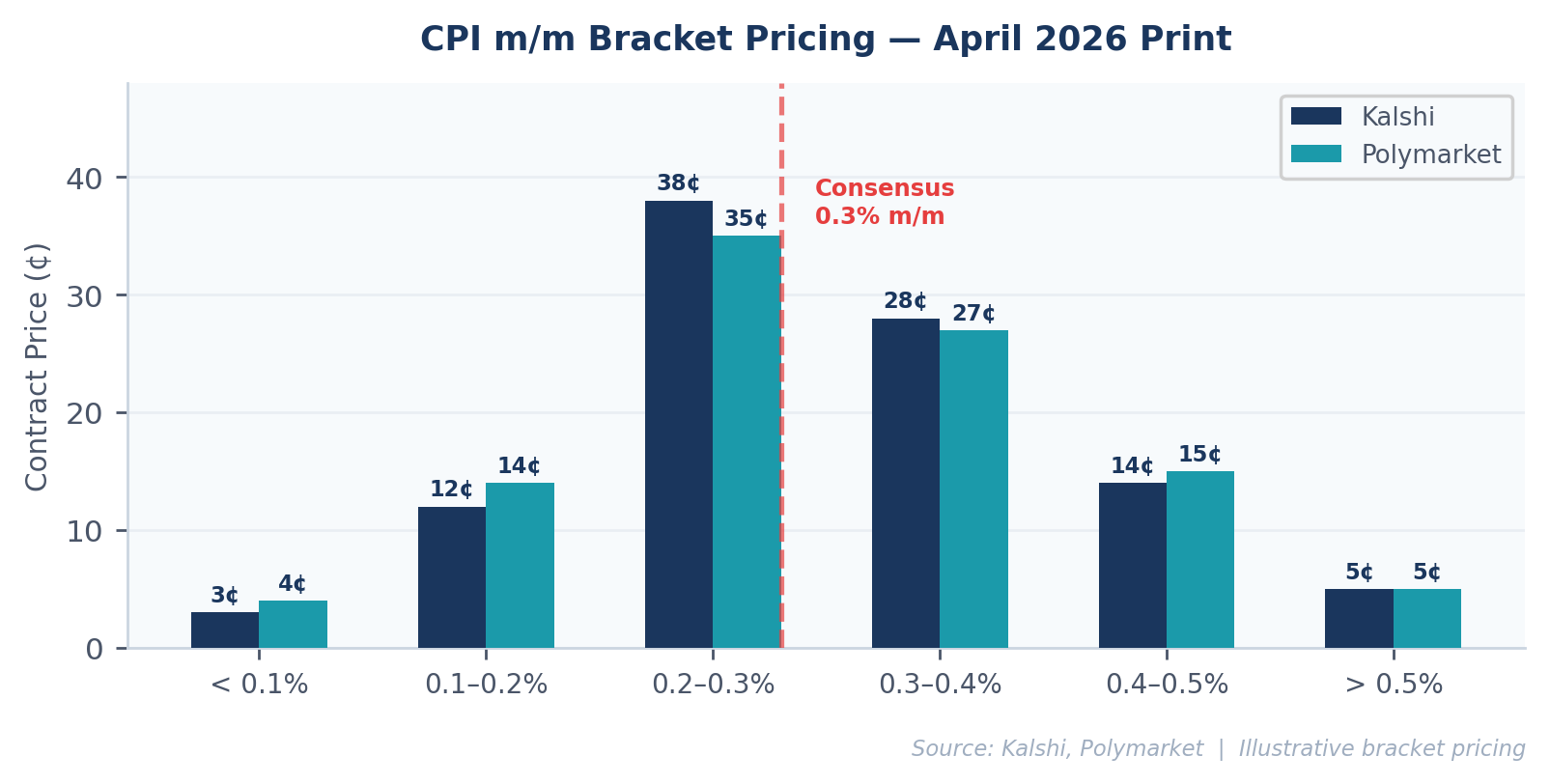
In the example above, both venues place most of the probability mass in the 0.2% to 0.4% range. The tails still have prices. That matters because two markets can share the same expected value while assigning very different probabilities to an upside or downside surprise.
A macro desk can use the distribution in several ways:
- buy a specific bracket when its internal forecast is more concentrated than the market's;
- buy both tails when the market appears too confident around consensus;
- construct a directional surprise position using adjacent brackets; or
- compare the prediction-market distribution with economists' forecasts, swaps, options, or the desk's own model.
The price is best treated as a probability signal before fees and execution costs. A 35-cent contract may imply roughly 35%, but the executable probability depends on the side of the book, available depth, and the price paid for the full order.
The same event can trade differently across venues
Economically similar contracts do not always have identical wording, resolution rules, tick sizes, or participant bases. Even when two markets map cleanly to the same outcome, their prices and liquidity can differ.
The April FOMC example shows broad agreement across three venues. Each assigned roughly 94% to 95% probability to no change, while the probabilities of a cut or hike remained small.
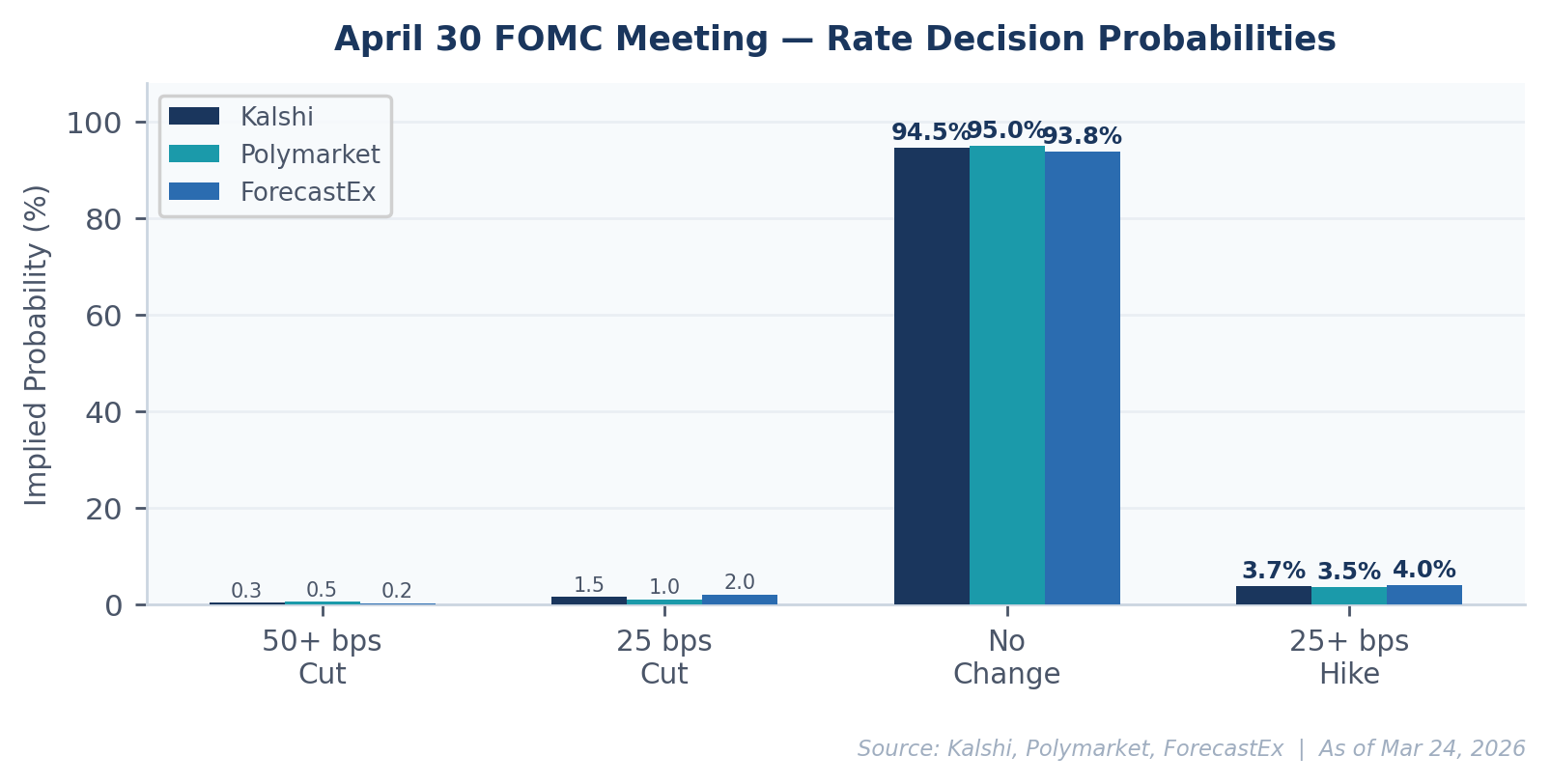
Agreement at the headline level does not mean the books are interchangeable. A desk still needs to check:
- whether the contracts use the same resolution source and cutoff;
- whether the listed outcomes cover the event in the same way;
- which side of each book is actually executable;
- how much size is available at each level; and
- how fees, collateral, settlement, and eligibility differ by venue.
A small difference in displayed probability may disappear after fees. A small difference backed by meaningful size may represent the better route. Price and depth have to be evaluated together.
Rolling the position is part of the strategy
Economics-linked contracts expire when the event occurs. There is no passive quarterly futures calendar that handles the roll for every series. The strategy must follow the release schedule.
Fed contracts roll from meeting to meeting. CPI and payroll contracts roll monthly. GDP follows the advance, second, and final estimate cycle. Initial claims can require a new position every week.
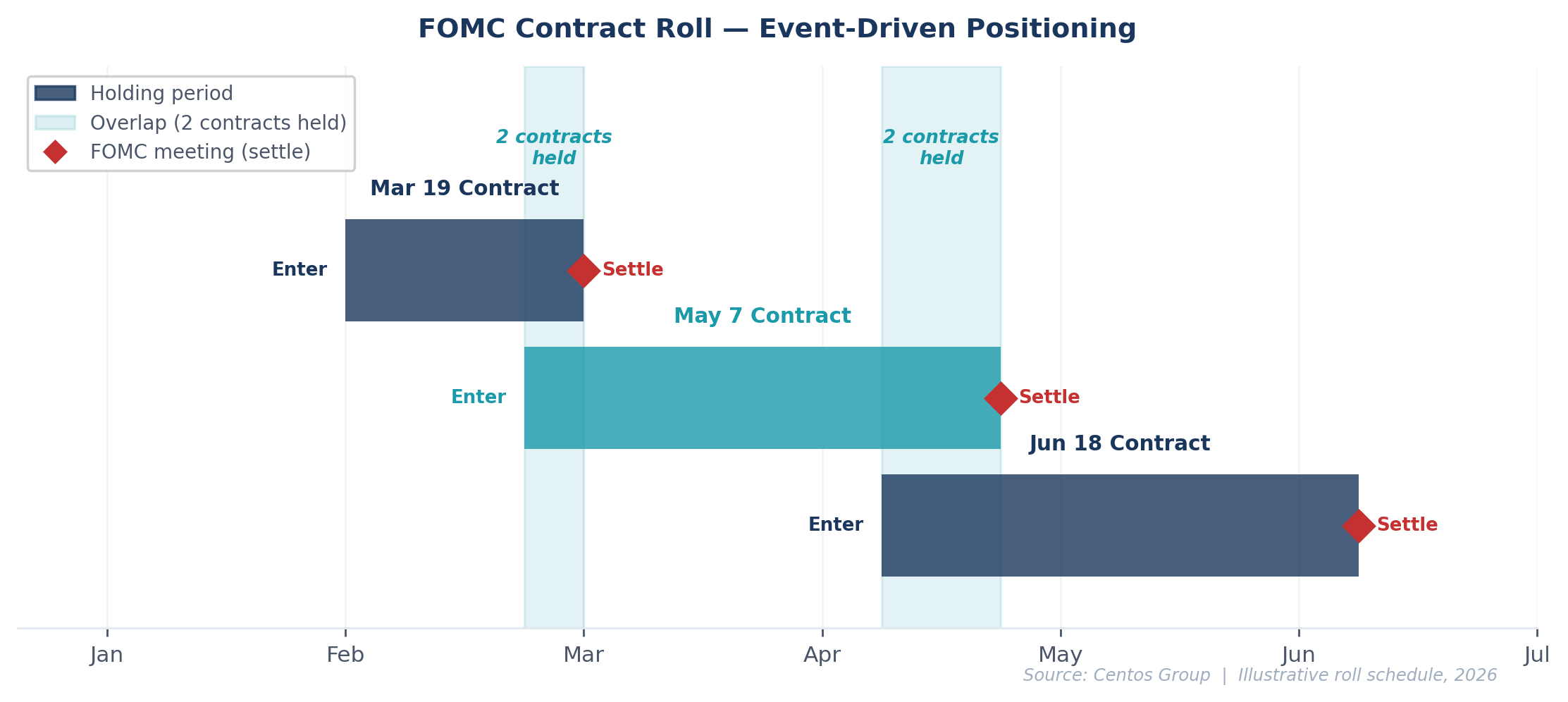
The overlap in Figure 3 is deliberate. Waiting until settlement to open the next contract can leave the strategy dependent on whatever liquidity remains after the event. Entering the next contract too early can tie up capital and expose the portfolio to two meeting windows at once.
A systematic roll policy should specify:
- when the next contract becomes eligible for entry;
- how quickly the position should be accumulated;
- whether the current and next contracts may overlap;
- the maximum capital allocated across concurrent events;
- when stale limit orders must be canceled; and
- what happens when a contract is delayed, revised, or defined differently from the strategy's reference series.
For an ETF or systematic fund, these rules belong in the index or investment methodology. They should not be improvised on the morning of the release.
Execution changes once the order gets large
The displayed best price only describes the first available level. A larger order consumes additional liquidity and receives a worse average fill unless the desk waits, posts passively, or routes elsewhere.
The April FOMC snapshot illustrates how liquidity can be distributed unevenly. At the best price, Kalshi and Polymarket each contribute part of the available market. Combining them produces a deeper executable book than either venue alone.
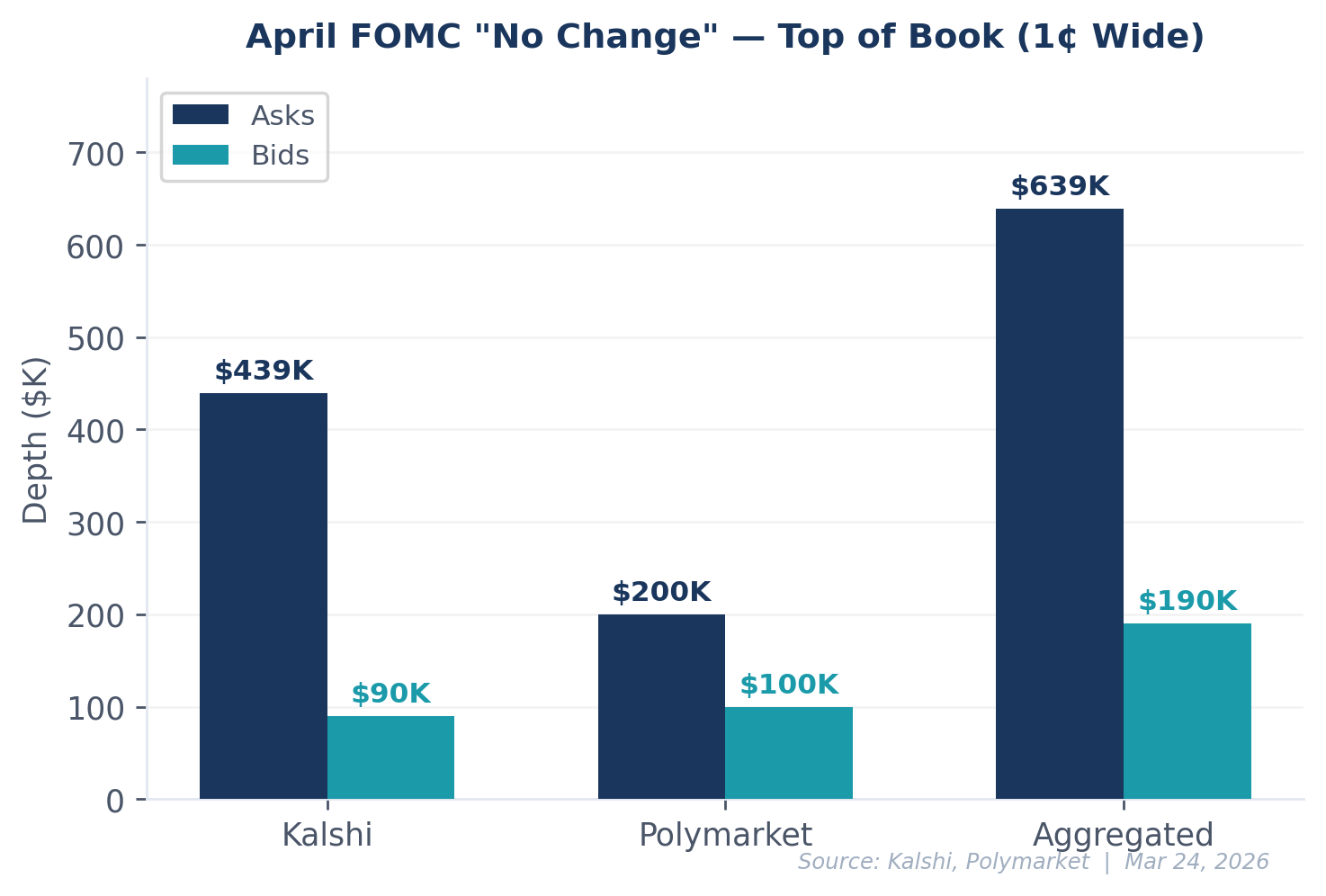
Neither venue supplies the full amount alone. The practical lesson is not that aggregation guarantees a better fill. It is that the best route depends on the order:
- A small order may fit entirely at one venue's best price.
- A larger order may need to sweep several levels at one venue.
- A router may improve the average fill by splitting the order across venues.
- A passive order may reduce fees or market impact, but it may not fill.
- A price discrepancy can exist only briefly and may disappear before both legs execute.
This is why an institutional workflow needs a consolidated view of price, depth, fees, limits, and current positions before sending the order.
Aggregation can reveal prices that a single book hides
Separate venues can occasionally form a crossed consolidated market. In the snapshot below, one venue displayed an ask below another venue's bid for an economically matched outcome.
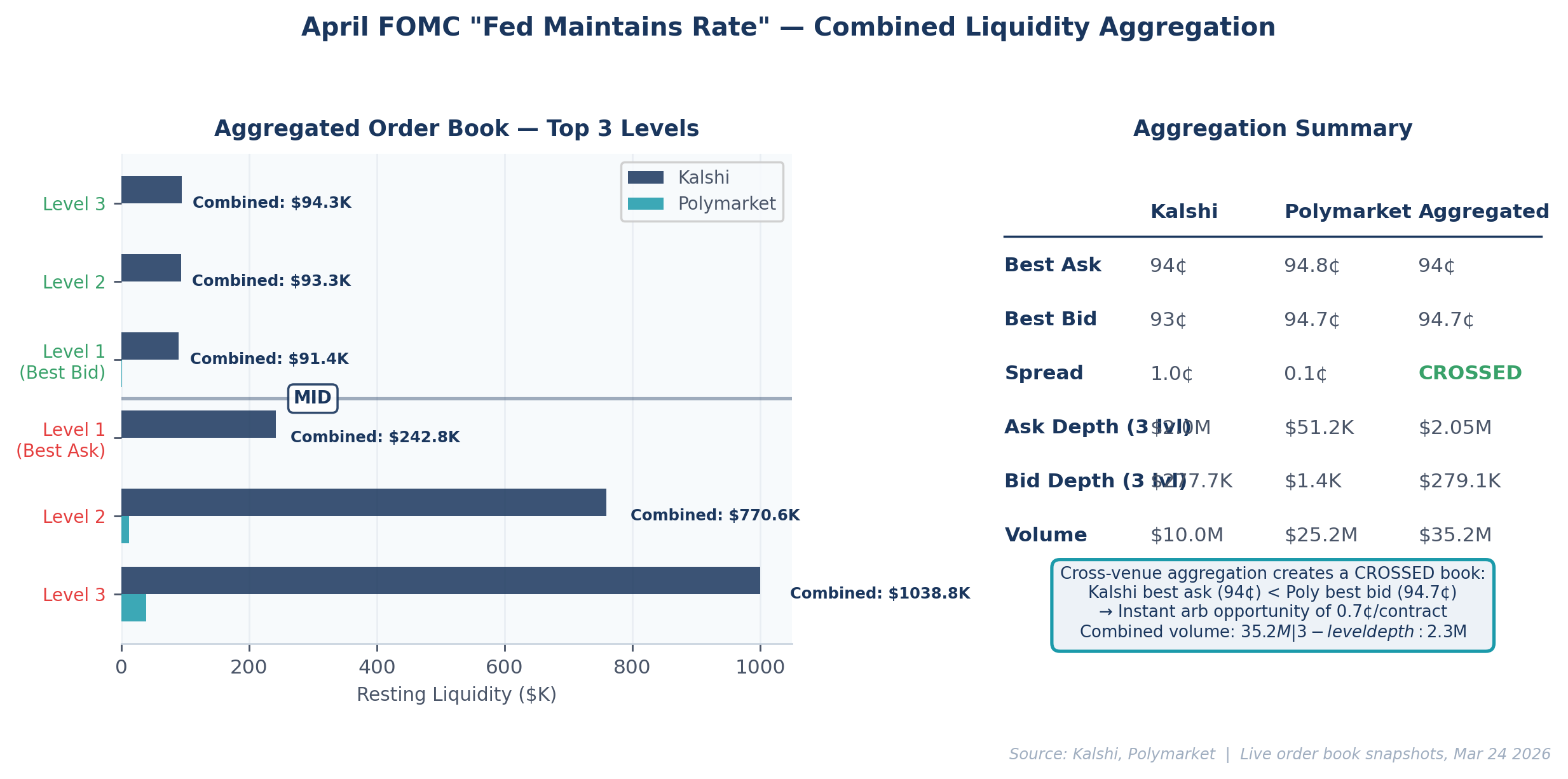
A 0.7-cent displayed cross is not automatically a 0.7-cent profit. Before treating it as an arbitrage, the desk has to verify:
- identical economic outcomes and resolution rules;
- sufficient size on both sides;
- trading and settlement fees;
- the risk that one leg fills and the other does not;
- collateral availability at both venues; and
- operational ability to reconcile positions across settlement rails.
The value of aggregation is broader than arbitrage. A consolidated book gives the trader a defensible execution benchmark. It also records where liquidity was available when the order was sent, which supports transaction-cost analysis after the trade.
A professional workflow has four layers
Trading the economic calendar systematically requires four connected systems.
1. Contract normalization
The system maps venue-specific tickers and rules to one economic event. Similar titles are not enough. The mapping should capture the settlement source, release date, outcome boundaries, revision policy, and edge cases.
2. Pre-trade controls
Before routing, the desk checks account eligibility, position limits, collateral, current exposure, and the maximum loss under every possible outcome. These checks must use the rules of the venue receiving the order.
3. Smart order routing
The router compares executable prices after fees, then allocates the order across venues and price levels. It should account for partial fills, stale quotes, venue latency, and whether passive execution is permitted by the strategy.
4. Post-trade reconciliation
Fills, fees, positions, and settlement cash flows have to be normalized into one record. Without that layer, a desk cannot measure the all-in cost of the trade or compare execution quality across venues.
Where these contracts fit in a portfolio
Economics-linked contracts can be used as standalone event positions or as overlays on a broader macro portfolio.
Potential applications include:
- a defined exposure to a Fed decision without taking general duration risk;
- a CPI tail hedge tied directly to the official release;
- a payroll surprise position paired with rates exposure;
- a distribution trade across several inflation brackets; or
- a systematic sequence of short-duration positions rolled across the economic calendar.
The appropriate size depends on liquidity, portfolio objectives, mandate constraints, and the loss that can be absorbed if the contract settles at zero. The $1 maximum payout makes contract-level arithmetic simple, but it does not remove concentration, liquidity, basis, operational, or regulatory risk.
The contract is simple. The infrastructure is not.
Economics-linked prediction markets give traders direct access to events that were previously expressed through instruments with broader risk. That is the appeal.
The hard part begins after the forecast. The desk must translate an economic view into the right contract, compare definitions across venues, plan the roll, source liquidity, control partial-fill risk, and reconcile the result.
For small orders, that process can remain manual. At institutional size, contract normalization, routing, and reconciliation become part of the investment process. A correct forecast is useful only if the desk can convert it into a filled, controlled, and reconciled position.